- HeraSphere
- Posts
- HeraSphere #32: Your Skin is a Report Card
HeraSphere #32: Your Skin is a Report Card
Sleep, stress, nutrition, wine...it all shows up in the mirror

Lilly Liu Minkove
March 23, 2026
Dear friends,
This issue comes a day late due to Spring Break. This holiday came with a side of reality check.
Just before Spring Break, I spent three days on the West Coast — poor sleep, late nights, more wine than water — and my face announced it immediately. Puffy. Dull. A gray exhaustion that no concealer was going to fix. On weeks when I'm sleeping well, moving my body, eating clean? My skin glows. Same products didn’t work when I trashed my system.
Your skin is your largest organ: a live report card for everything happening inside you: your hormones, your sleep quality, your stress load, your hydration. And here's a stat worth knowing: 80–90% of visible facial aging is caused by a single preventable factor — sun exposure. Most of what we think of as "just aging" is decades of UV damage made visible.
I went deep on skin care after listening to Dr. Shereene Idriss, one of the most trusted board-certified dermatologists in the world. Here's what I learned — and how it holds up against my own routine.
The TL;DR
Your skin is your body's largest organ and a live feedback system for everything happening inside you.
Up to 90% of visible aging comes from UV damage — not genetics, not time.
The foundation is three products: a gentle cleanser, a moisturizer, and a broad-spectrum SPF.
Understand what tone, texture, and sensitivity actually mean, use actives that match the problem
Your lymphatic system, your facial muscles, and your collagen are all part of the same picture.
The basics: protect yourself from the sun, sleep, eat well, manage stress.
What Your Skin Is Actually Doing
Your skin has three layers — and most of the aging you care about is happening in the one your products can't reach. The outermost layer, the epidermis, produces new cells, houses melanin (your natural pigment), and forms the barrier that keeps moisture in and irritants out. Below it sits the dermis — the structural layer where collagen and elastin live. Think of collagen as the scaffolding that keeps skin firm, and elastin as the snap-back quality that lets skin return to its shape after movement. The deepest layer, the hypodermis, is made up of fat cells that act as cushioning — and the fat pads that shift with age. Most topical products work at the epidermis. The visible changes women notice in their 40s and 50s — sagging, deeper lines, loss of firmness — are happening in the dermis. Different layers, different problems, require different tools.
Collagen starts declining in your mid-20s at about 1% per year — and UV exposure accelerates that breakdown. This is the mechanism behind the 80–90% stat. UV radiation degrades collagen and elastin in the dermis, damages the DNA of skin cells, and triggers melanin overproduction that shows up as spots and uneven tone. Unprotected sun exposure quietly dismantles the structure of your skin every day.
Two biological moments exist when skin change feels sudden, not gradual. The first happens in your late 20s to early 30s — subtle, hard to name, but real. Collagen shifts from a growth phase to a maintenance phase. The second is around age 44, when Stanford Medicine researchers documented a measurable molecular shift: cells begin aging faster at a biological level. For women, this lands directly on top of perimenopause. As estrogen declines, skin becomes thinner, drier, and less able to hold hydration. Cell renewal — the process of shedding dead cells and replacing them with fresh ones — slows by about 10 days per decade on top of the baseline 28-day cycle. By your late 40s, dead cells sit on the surface noticeably longer, which is why texture, tone, and radiance all seem to shift at once.
The Three Skincare Products That Do Most of the Work
Nobody needs a 12-step routine — and more products usually make things worse, not better.
The cleanser's only job is to remove the day without stripping the skin. Use it at night; water only in the morning, especially important in perimenopause when skin is already losing its ability to retain hydration. Water temperature matters: hot water strips the protective oil layer your skin spent all night rebuilding, so lukewarm is the move. A fresh washcloth beats rubbing with your hands. Makeup wipes should not be a daily habit: think about wiping foundation off a porous orange. You're not removing it, you're pressing it into the surface. Fine as an occasional fallback, not as your go-to cleanse.
Moisturizer should be calibrated to your environment and your current skin state. Perimenopausal skin needs more barrier support because estrogen decline reduces the skin's natural ability to hold water. Look for ceramides (fats that reinforce the barrier), glycerin (a humectant — meaning it draws water into the skin and holds it there), and hyaluronic acid (another humectant that holds up to 1,000 times its weight in water). One label note: "collagen" on a moisturizer means it's hydrating. Collagen molecules are too large to penetrate the dermis topically — they can't replenish structural collagen. Know what you're buying.
Broad-spectrum SPF is the highest-return product in skincare — and still the most skipped. Broad spectrum means protection against both UVA and UVB. UVB causes sunburn and DNA damage to skin cells. UVA penetrates deeper, degrades collagen, and drives the premature aging we can actually see — and it's present year-round, on cloudy days, through windows. There is no safe tan. Any UV-triggered change in skin color is evidence of DNA damage. SPF 30 math: if you'd burn in 10 unprotected minutes, SPF 30 gives you roughly 300 minutes of protection. The best SPF is the one you'll actually wear consistently — finding a texture you like is critical.
Actives: Ingredients That Work
Retinol and its prescription cousin tretinoin are the most clinically validated anti-aging ingredients in existence. Both are vitamin A derivatives. Tretinoin (prescription) is the active form — it works faster and is more potent. OTC retinol is the inactive form: it converts to retinoic acid on the skin, which takes longer but is gentler. The mechanism: retinol speeds up cell turnover, stimulates collagen production in the dermis, and regulates how cells differentiate — originally developed for acne, with significant anti-aging effects discovered later. The rule is consistency over intensity. Start at the lowest OTC concentration, four to five nights a week, and let your skin adapt before escalating. Over-applying is how people burn their face, get discouraged, and quit.
Vitamin C is an antioxidant. Free radicals are unstable molecules generated by UV exposure and pollution that break down collagen and accelerate aging. Vitamin C neutralizes them before they cause that damage, and also stimulates collagen synthesis and addresses uneven tone and brown spots. The active form — L-ascorbic acid — is more potent but can irritate fair or reactive skin. Inactive forms like ascorbyl glucoside are gentler and still effective. Use it in the morning under SPF: the two work synergistically, with vitamin C amplifying SPF's protective effect.
Niacinamide — vitamin B3 in skincare form — is the workhorse nobody talks about enough. It reduces redness and inflammation, fades hyperpigmentation, helps with enlarged pores, and strengthens the barrier. One of the lowest-risk actives available; it plays well with retinol, vitamin C, and most other ingredients. Particularly useful for the redness and uneven tone many women start noticing as estrogen declines.
Hyaluronic acid shows up in almost every moisturizer, which means you probably don't need it as a dedicated extra step. It's a humectant — it attracts and holds water, creating a temporary plumping effect. One caveat: apply it to damp skin. In dry climates, HA applied to dry skin can actually pull moisture out of the deeper layers of your skin rather than drawing from the air, leaving skin more dehydrated than before.
Your Lymphatic System: Why You Feel Puffy and What to Do About It
The puffiness after a bad night of sleep is because your drainage system backed up. The lymphatic system is a network of vessels, nodes, and organs running throughout the body whose job is waste clearance: it collects excess fluid, dead cells, metabolic byproducts, and immune cells from your tissues and moves them toward lymph nodes, where they're filtered and cleared. Unlike your cardiovascular system — which has the heart as a pump — the lymphatic system has no dedicated pump. It moves entirely through muscle contractions, breathing, gravity, and physical stimulation. When it stagnates, fluid accumulates in the tissues, and you see it immediately on your face.
Alcohol is a particularly effective lymphatic disruptor, which is why it shows up on your face the next morning. It dehydrates you systemically while simultaneously triggering inflammation that increases fluid in the tissues: a double hit that produces puffiness, dullness, and a slightly blurred jawline. My West Coast trip was a live demonstration. Sleep deprivation compounds this: during sleep, the lymphatic system does significant clearing work throughout the body. Cut the sleep, and the waste sits in the tissue.
Aging makes lymphatic clearance slower — and the consequences go beyond morning puffiness. The lymphatic system becomes measurably less efficient over time. A 2015 Japanese study found a direct link between reduced lymphatic activity in facial skin and sagging, which means consistent drainage isn't just about de-puffing the morning after a late night — it's connected to how the lower face maintains its structure over years.
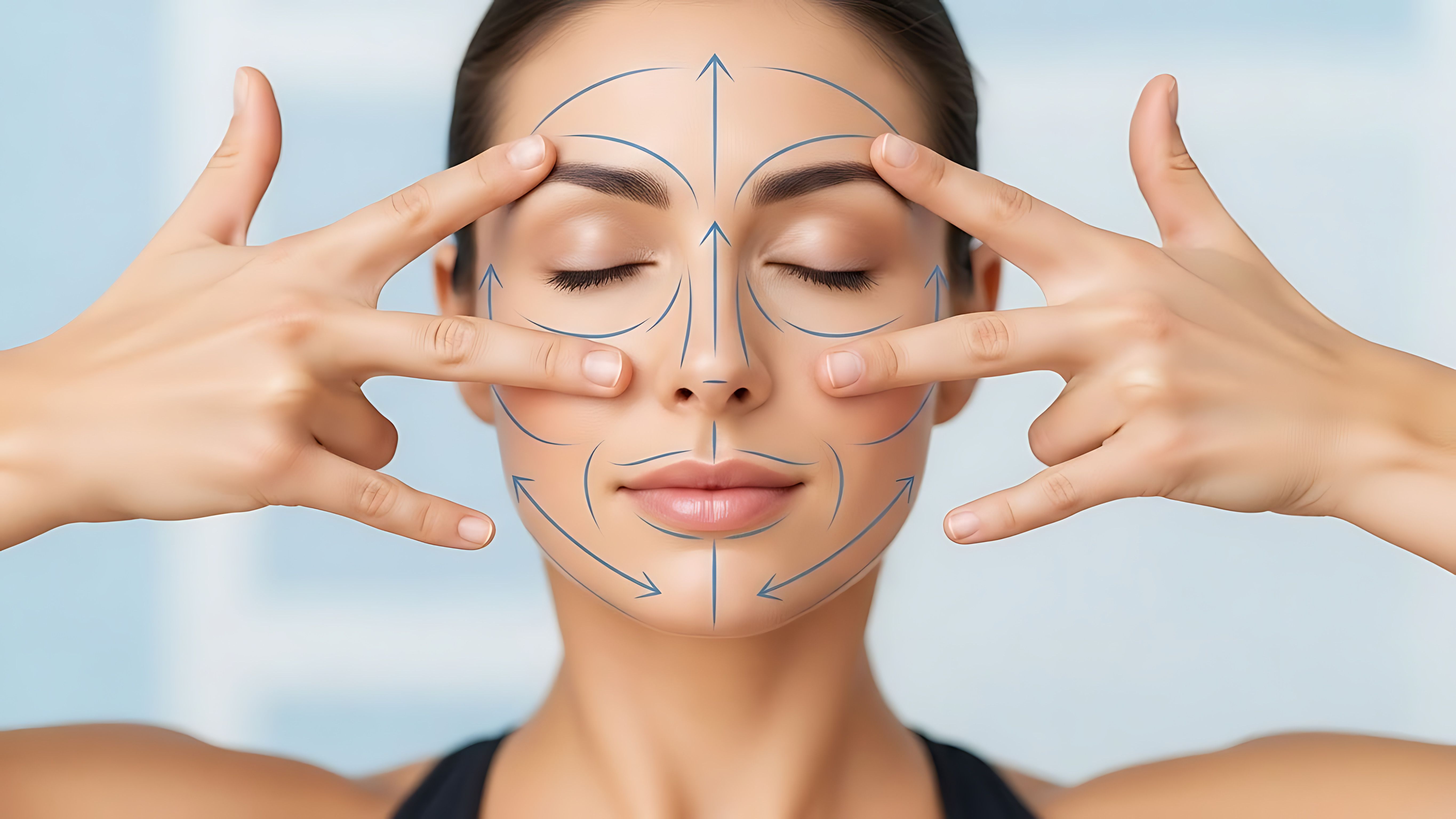
The fix is directional movement — always downward and outward toward the lymph nodes. For the face: gentle strokes moving from the center outward, then down the sides of the neck toward the collarbone, which is where lymph drains. Light pressure only — lymphatic vessels sit just beneath the skin surface and respond to touch, not force. Even 60 seconds of deliberate downward neck strokes after waking can visibly reduce morning puffiness. Gua sha and facial rollers are lymphatic drainage tools at their core; the direction matters, not the material. Cold tools — chilled gua sha, cryo wands — add a vascular constriction effect (blood vessels tighten temporarily, accelerating fluid clearance) and are particularly effective before an event. Hydration and movement are the best upstream inputs. In fact, walking is one of the most effective whole-body lymphatic activators there is.
Facial Yoga is Backed by Science
Facial aging isn't only a skin story — it's also about the fat pads and muscles underneath losing volume and tone, which causes skin to shift downward. Facial yoga targets the muscle layer directly: isometric contractions (exercises where a muscle works against resistance without changing length, like pressing your tongue hard toward the roof of your mouth) can build facial muscles the same way resistance training builds muscle elsewhere. Thicker, stronger facial muscles create a firmer foundation for the overlying skin to sit on.
I do a tongue-to-nose move that specifically reduces a double chin. To do it: open your mouth slightly, extend your tongue upward toward your nose as far as it will reach, and hold for 10 seconds. Release. Repeat 10 times. The contraction works the muscles that define the underside of the chin and resist gravitational pull on the lower face. It won't reverse structural bone changes (the main driver of jowling) but it can meaningfully affect how the overlying tissue sits on top of that structure.
The evidence for facial exercise is real, if still limited in scale. A 2018 Northwestern University clinical trial published in JAMA Dermatology had participants aged 40–65 perform facial exercises over 20 weeks. Two blinded physicians assessed photographs without knowing which participants had done the exercises and found significant improvements in mid-face and lower face fullness — estimated apparent age dropped by roughly 2.7 years. A 2024 clinical study found the digastric muscle, exactly the muscle involved in the tongue-to-nose contraction, showed the most significant gains in tone and elasticity following a consistent facial yoga program.
There's also an immediate lymphatic benefit that explains why results feel visible right away. Every time you contract a facial muscle, you move the lymphatic fluid in the surrounding tissue — which is why facial exercise produces a visible de-puffing effect almost immediately, alongside the slower muscle-building benefit that accumulates over months. Pair the contraction set with two or three slow downward strokes along the sides of the neck toward the collarbone — it takes 30 seconds and clears what the muscle work just loosened. The data shows meaningful structural change at 20 weeks of consistent effort; traffic light practice is a start, but daily is where the benefit compounds.
Check out facial fitness exercises for jowls by Valeriia Veksler, a facial fitness nurse, on IG.
What I Actually Use — and How It Holds Up
La Roche-Posay Toleriane Purifying Foaming Cleanser at night, water only in the morning. Gentle, barrier-respecting, doesn't strip. The morning water-only approach is particularly smart for skin managing hormonal hydration changes.
OneSkin OS-01 serum and eye cream target skin aging at the cellular level. OS-01 is a unique peptide that works on cellular senescence — the accumulation of aging cells that stop functioning but don't clear out, dragging surrounding healthy cells down with them. Use my link for $30 off first order of $150 or more.
All Moringa organic facial oil is a new step in my routine. Moringa oil is cold-pressed from the seeds of the moringa oleifera tree — sometimes called "the miracle tree" because virtually every part of it has documented benefits. For skin, it's rich in oleic acid (a fatty acid that closely mirrors the skin's own natural oils, making it absorb quickly without feeling heavy), antioxidants that neutralize free radical damage, and anti-inflammatory compounds that calm redness. A few drops after serum, before moisturizer. It makes everything that goes on top of it work better.
Hyaluronic Acid by The Ordinary layered on slightly damp skin keeps hydration locked in.
La Roche-Posay Toleriane Double Repair Moisturizer is light weight but keeps my skin moist.
La Roche-Posay Anthelios Sunscreen during the day. I purchase my Anthelios in Europe when I can, because European formulations use a broader range of UV-filtering molecules than U.S. formulations. The FDA's approval process for newer filters runs years behind the EU's, resulting in a lighter texture that's genuinely easier to wear every day.
Sungboon Editor Deep Collagen Overnight Mask is a weekly hydration treat. This mask delivers a plumping, hydrating effect that's genuinely useful before a long day or an event. My skin gets an incredible glow the next day and the fine lines disappear temporarily!
Vital Proteins Collagen Peptides and facial yoga are both things I do when I remember — which sadly means I'm not getting the full benefit of either. Daily consistency is where results live. Working on it.
I realized I need to add back Vitamin C and Niacinamide to my routine…
Remember what's actually upstream of all of it. Sleep shows up on your face — in the lymphatic fluid that didn't drain, the cortisol that spiked, the collagen repair that didn't happen during the hours you didn't get. Nutrition shows up on your face — in the inflammation, the dullness, the slowing cell turnover from a diet that isn't supporting the system. Stress shows up on your face — through the same disruptions that affect your hormones, your gut, and your immune function. My West Coast week made all of that visible in a way no overnight mask was going to fix.
Skincare isn't just about products. When you're sleeping, moving, eating well, and keeping stress in check, the products amplify something that's already working. When you're not, no routine fully compensates. The skin is just reporting how you’re taking care of your health.
Here's to more collagen: the kind you build from the inside out,
— Lilly
P.S. Forward this to a friend who stands in front of her mirror every morning wondering what's going on with her skin. She needs the full framework, not more products.
If you’ve received this email from a friend and want to receive it in your own inbox
Note: While I love diving deep into research and sharing what I've learned about women's health and wellness, I want to be crystal clear: I'm a passionate health advocate and researcher, not a medical professional. Think of me as your well-informed friend who does extensive homework – but not your doctor.
Everything I share in HeraSphere comes from careful research and personal experience, but it's meant to inform and inspire, not to diagnose or treat any medical conditions. Your body is uniquely yours, and what works for one person might not work for another. Always consult your healthcare provider before making significant changes to your diet, exercise routine, or wellness practices, especially if you have underlying health conditions or take medications.
ICYMI, here are a few past issues that you may enjoy:



Reply